politics of food
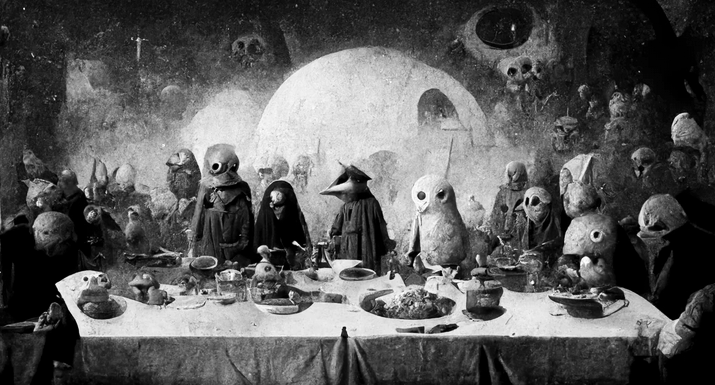
Food is political. Not as a slogan, but as a structure. Every meal is embedded in property relations, subsidy systems, supply chains, working conditions, and historical continuities. A tomato does not simply grow; it is the result of land distribution, access to water, wage labor, trade agreements, and logistical infrastructure. Agricultural policy structures markets, and large corporations bundle control over seeds, processing, and distribution. Those who eat, move within this architecture. Politics here is not a commentary, but a precondition. Access to food also follows economic lines. Price, time, infrastructure, and education determine what ends up on the plate. When fresh food is expensive and highly processed products are cheap, that reflects priorities. Nutrition becomes a social marker. Class relations materialize in everyday life, quietly and visibly at the same time. Not as individual failure, but as an expression of distribution.
At the same time, the body is a site where political norms are negotiated. Nutritional discourses produce ideals: pure, disciplined, efficient, controlled, optimized. Health is morally charged, eating becomes a question of virtue or weakness. A narrow line runs between self-care and self-optimization. Whoever defines what counts as right sets standards for bodies and behavior. Food regulates not only our metabolism, but also belonging.
It is not only an expression of power, but also an instrument of regulation. Look at what happens when people eat together. Even in tense situations, shared meals demonstrably reduce aggression. Why? Because they move us from fight or flight into connection. The body regulates itself. People share. They wait. They listen. That is already a political act because it places relationship before confrontation.
In crisis zones, the first act is cooking. Not analyzing. Cooking. Warm food signals: you are worthy of being cared for. That is dignity. And dignity is the foundation of peace. Provision here is not a gesture of kindness, but an affirmation of humanity. An embodied stance.
Food can function as a protected space. Those who eat together declare themselves, at least temporarily, non-hostile. This gesture is older than modern statehood. It marks a zone in which violence is suspended to allow encounter.
Who cooks? Who is allowed to sit at the table? Who is excluded? A place of peace does not arise automatically from a table, tableware, and bread. It arises through conscious design. Whom do I invite who would otherwise not be heard? Which hierarchies do I unconsciously reproduce? Is my table truly open, or merely aesthetically diverse? What happens when we are truly present, without phones, without roles, without defense?
That is peace work within ourselves.
And peace is not harmony. A table can also be a place of honest confrontation. Perhaps the real political core of eating together lies not in avoiding conflict, but in enduring it within a safe frame. A meal then becomes a space in which difference does not escalate, but is held. In that, the radical dimension of food as action becomes visible.
