the nomadic kitchen does not exist.
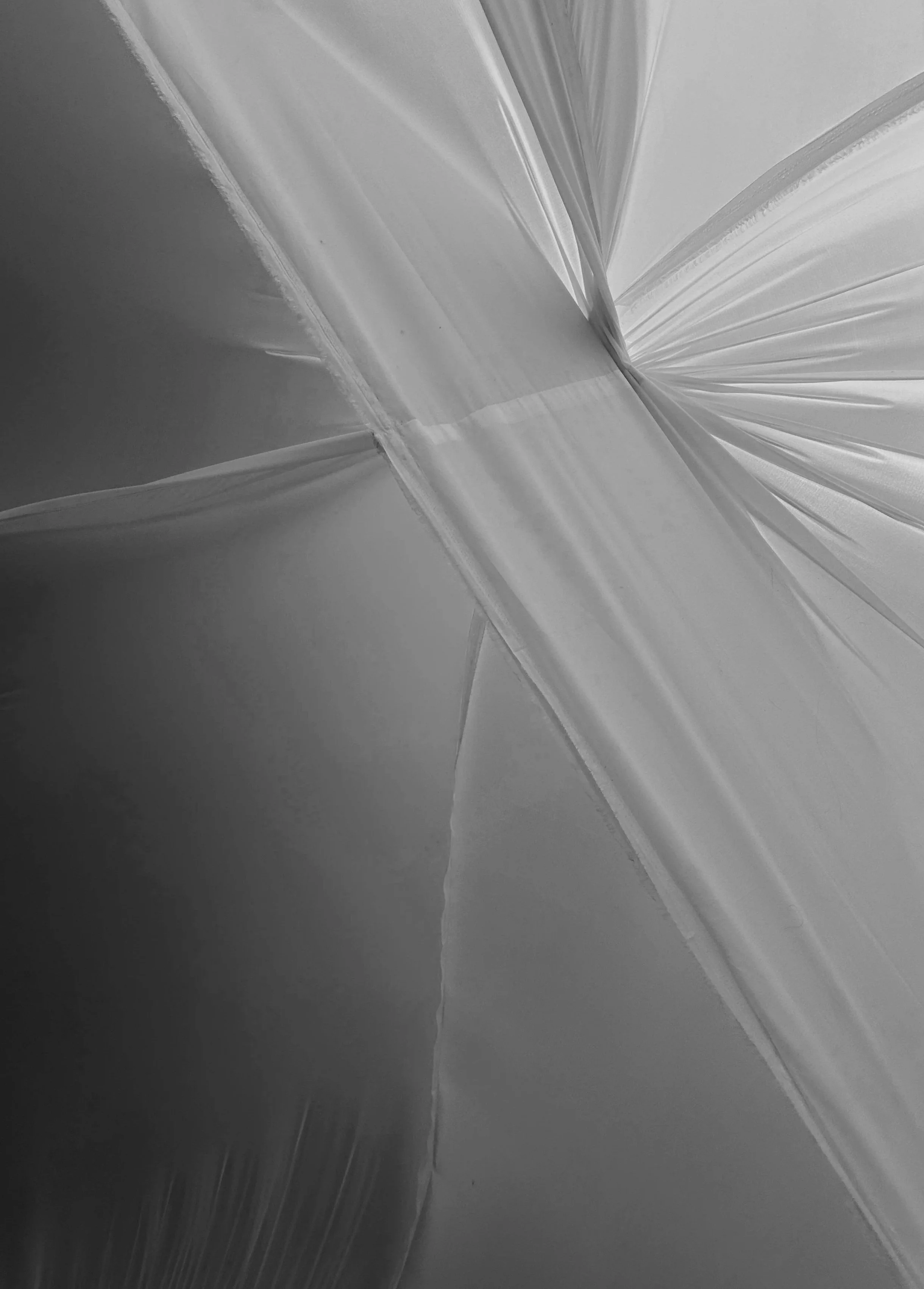
It emerges. It settles. It moves on.
I. soft walls
What if the kitchen were not a room, but a gesture?
We begin with a thesis that has no foundation, and that is intentional. Soft Architecture, as thinkers like Yona Friedman imagined it, rejects the claim of the permanent.
No concrete. No finality. Instead, membranes, textiles, air as building material.
Gottfried Semper wrote in the nineteenth century that the wall, the wall surface and not the structural wall, has its origins in weaving. The German word Wand comes from winden: to twist, to braid. The first architecture was a woven curtain.
What, then, is a kitchen that returns to this curtain? It is not a room anymore. It is a boundary that breathes. A skin that can be put on and taken off, stretched across a courtyard or folded into the back of a van.
It is architecture that remembers it was once a textile.
The practice of Soft Architecture is around exactly this premise. Textile construction inverts the usual logic of building.
Air becomes a building material, a floating volume that frees space and movement. The wall does not enclose.
II. the stove moves
In 1992, Rirkrit Tiravanija entered 303 Gallery in New York and cooked curry. No painting on the wall. Only a wok, heat, steam, and the silence that emerges when strangers eat together.
He called it Untitled . The artwork was the disappearance of the boundary between studio, kitchen, and community.
Since then, this kitchen has traveled the world. The Hirshhorn Museum. MoMA. The Kleinmarkthalle in Frankfurt. Tiravanija cooks, or lets others cook, and each time the space is different while the hearth stays the same.
This is nomadic architecture in a way: not the house that travels, but the ritual that keeps landing.
His work is rooted in so called relational aesthetics, a practice that takes the whole of human relations and their social context as its starting point, rather than an independent and private space. The gallery becomes a kitchen. The kitchen becomes a commons. The meal becomes the work. The table is the only threshold that needs no door.
III. cuisine as construction
In Zurich, architect Blanka Major with her project food forms, works at precisely this intersection. Her practice understands the kitchen as a format of collectivity. Cooking and eating become tools of inquiry and formats for gathering, dissolving boundaries and creating temporary communities. Her performative dinners at Kunsthalle Bern and Kunsthaus Zurich are not events. They are buildings that unfold and then dissolve.
Collectif Kitchen went further and drafted an explicit typology of collective kitchens across Brussels: the peri-urban kitchen, the neighbourhood kitchen, the shared kitchen, and, listed with full seriousness as an architectural category, the nomadic kitchen.
A type that refuses to settle. A space that is defined not by its walls but by its recurrence.
What connects these places and practices is not a shared aesthetic. It is a shared understanding that cooking is not what happens inside architecture. Cooking is architecture, for as long as the fire burns.
IV. who decides when nomadism becomes a concept?
There is a moment when the term tips over. Nomadic kitchen sounds like freedom. Like lightness. Like an architecture that does not take itself too seriously. But freedom is not a neutral word, and lightness has a cost. The question is only: whose?
A precise distinction runs through the critical discourse on nomadism, drawing on Deleuze, Guattari, and Agamben: there are two kinds of movement. Movement as a life, and movement as a lifestyle. On one side, existential disruption. On the other, the privilege of free choice. Both can look identical from the outside. Both sometimes call themselves nomadic. But they inhabit completely different worlds.
“The difference between the nomad and the displaced person is not aesthetic. It is a difference of power.”
The research on gentrification is unsparing on this point. In Boyle Heights, Los Angeles, landlords and urban planners used local cuisine, murals, and cultural life as attractors for investment, without protecting the community that had produced that culture in the first place. The restaurant becomes a backdrop. The recipe becomes a brand. The people who had cooked and eaten and lived in that neighbourhood for decades end up paying the rent for a version of their own life they can no longer afford.
Pop-up kitchens in upgraded districts. Temporary food concepts in former factory halls. Nomadic restaurant formats in art spaces. None of this is wrong in itself. But it demands a consistent question: whose temporality is being celebrated here? Who can leave when the concept runs out? And who stays, because they have nowhere else to go?
Nomadism that was not chosen is called displacement.
By way of contrast: the Portable Community Kitchens developed at the University of East London for the Southwark Day Centre for Asylum Seekers, in 2019 and 2020, are also nomadic kitchens. Transportable, temporary, adaptable. They fold down to pass through a church door. But they emerge from an entirely different logic, not from the will to ephemerality as form, but because no fixed space is available. Because the body cooking there has no home.
Soft Architecture, as a concept, appears politically innocent at first. Flexible structures. Textile membranes. Spaces that transform. But innocence does not hold for long when you ask who can afford a soft architecture.
Being soft costs something. A pneumatic pavilion that can be dismantled in a week requires production means, planning, and budget. The ephemeral is often the most expensive.
Lina Bo Bardi understood this. Her notion of soft architecture was not meant aesthetically but bodily. She meant spaces that subordinate themselves to life, not the other way around. Spaces that do not discipline the inhabitant. Spaces that listen.
That is a different kind of softness than that of the design pavilion.
There is a softness that invites. And a softness that displaces, by staging the displaced as atmosphere.
V. what remains
Perhaps the nomadic kitchen is not a place. Perhaps it is a question we can pose anywhere: what happens here when someone cooks? Who sits? Who stands? Whose recipe? Whose fire?
studiogor does not claim an answer. But we claim the question as a permanent companion to this project. Every time we speak of a nomadic kitchen, every time we sketch a temporary format or describe a place where cooking becomes architecture, we ask first: whose nomadism is this? Who has the choice to leave? Whose knowledge lives in the recipe? Whose body stands at the stove?
The nomadic kitchen of studiogor is only honest if it does not decorate these questions but carries them. If the ephemeral is used not as an aesthetic but as an ethical position. If temporality does not mean: we dismantle the concept and move on. But rather: we stay as long as the place and the people who inhabit it need us to. That is the hardest part of soft architecture. Not the construction. It’s timing.
