feeding the void
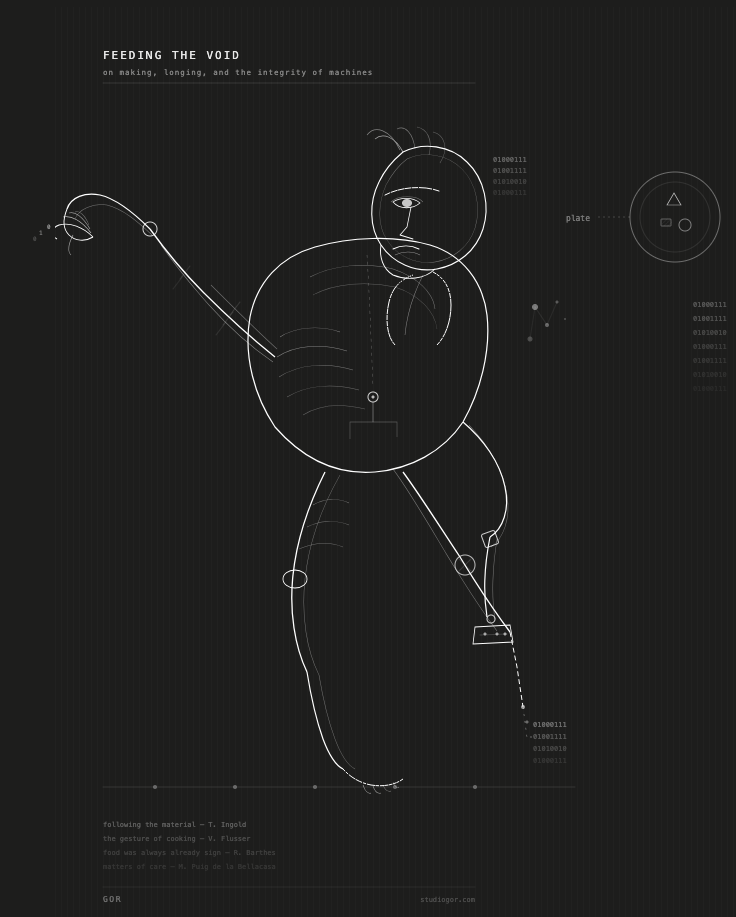
AI Adam meets God and hunger 1
on making. longing. and the integrity of machines
There is a moment in cooking that cannot be photographed. Not because it moves too fast, but because it shows nothing. The hand holding the pot. The small correction that comes from the body before the mind has decided. The knowledge does not sit up top. It sits somewhere between shoulder and wrist, and it has no image of itself. Vilém Flusser described the gesture of cooking as one of the oldest technical gestures of the human being. Not tool in the mechanical sense, but translation: raw world becomes inhabitable world. Fire, water, time, attention. For Flusser, the kitchen is not a space of reproduction but an epistemic site. A place where knowledge is generated that cannot be written down, because it lives inside the doing.
Tim Ingold calls this following the material. In Being Alive he describes making not as the imposition of form but as accompaniment. The basket weaver does not force a basket onto the reed. She responds to what the reed does, its resistance, its flexibility, its particular behaviour on this morning. What results is the record of a conversation, not the execution of a plan.
This sounds far from the machine. But perhaps the distance is smaller than it appears.
When a model generates an image of food, it follows something. Not reed, not heat, not the smell of onions in hot fat. It follows the weight of everything humans have ever recorded about eating. Millions of gestures of showing, sharing, remembering, compressed into a statistical structure that knows how light should fall on a plate without ever having known hunger.
Whether this constitutes making in Ingold's sense is not a question I want to close. But it is not mere execution either. It is a form of following that returns something to us which came from us, only compressed, smoothed, freed from the particular days that surrounded the originals. María Puig de la Bellacasa writes in Matters of Care (2017) that care is not an attitude and not a feeling. Care is a practice. It is what must be done for something to continue. Cooking food for someone is care in this sense: not emotion but action that produces continuity. The warmth of a meal is not metaphorical. It is physical, and it is political. When we ask whether a machine can care, we shift this question. The machine produces no warmth in the physical sense. It generates images of warmth. And these images produce real responses in real bodies. This is not a simulation of care. It is something third, for which we do not yet have a name.
Puig de la Bellacasa would likely ask: who benefits from this care, and who carries its costs? The image of steaming soup costs no one anything and reaches millions. Cooking the soup itself costs time, labour, attention, body. Both produce something real. But not the same real.
Yuk Hui has shown that the relationship between human beings and technology is not a universal story. In Recursivity and Contingency (2019) he argues that different cultures have developed fundamentally different cosmotechnics: different ways of embedding technology within a world order, of relating it to the living, of defining what it may and may not do.
The machine that generates food is not neutral. It carries a particular cosmotechnic within it, a western, capitalistically optimised, scalability-oriented conception of what food is and for whom it should look beautiful. The model was trained on images that did not appear by accident. It reflects back what was documented, and what gets documented is never everything.
The kitchen that was never photographed, that had no archive, that left no trace, is absent from the model. Not because it did not exist. Because it remained invisible. What the machine produces is also an image of whose hunger was considered worth showing. Roland Barthes wrote in 1961 that food was always already sign. The recipe is code. Cooking is compilation. Eating is execution. And as with any code: what the writer intended and what the programme does are related but not identical things.
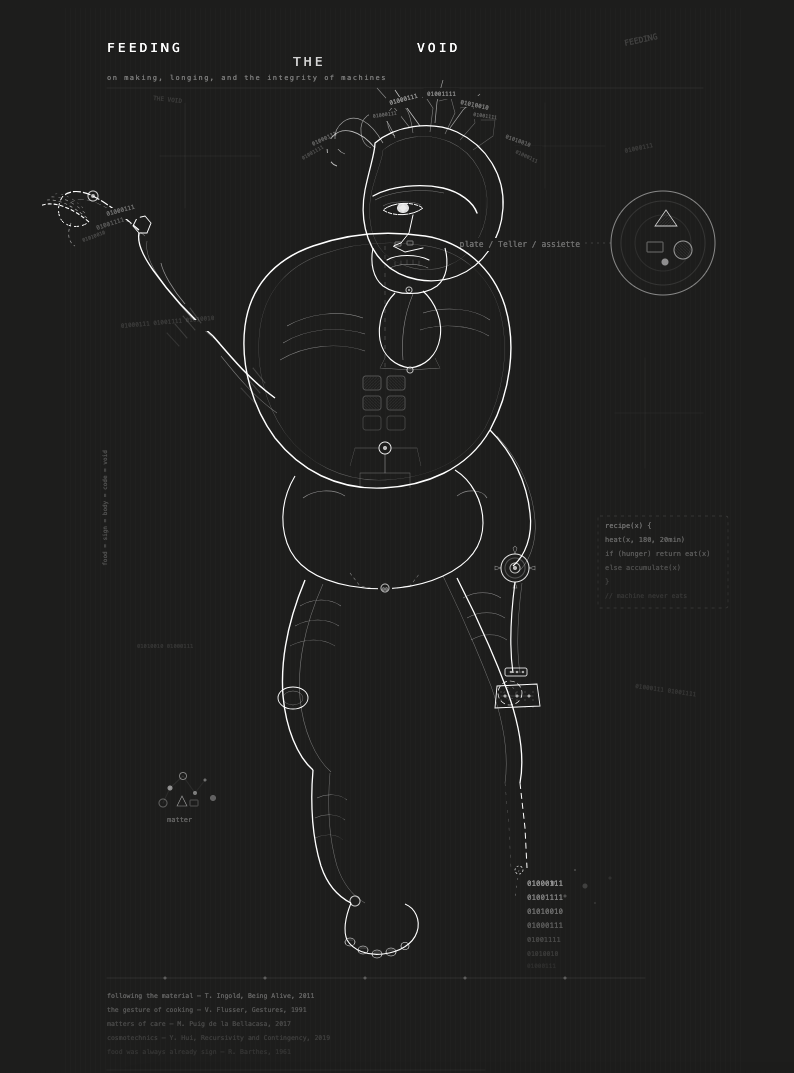
AI Adam meets God and hunger 2
In the space between the recipe and the plate, the essential thing happens. The deviation. The moment someone decides to add more salt because today is a different day. The machine does not know this day. It knows the statistical probability of the day. That is not nothing. But it is not the same thing.
The half-space between digital and bodily is not a transitional space. It is a space in its own right, with its own logic. Within it, the image of food operates differently from food itself, and differently from the memory of it. It is neither representation nor invention. It is a compression of human looking, returned in a form that produces hunger without being able to satisfy it.
That is the most honest thing one can say about the machine. It accumulates. It compresses. It returns. But it does not eat. And in the end, it always takes a body to complete the act. Someone has to empty the plate. That cannot be translated into the digital without losing precisely what the whole thing was about.
